Sunday, 31 July 2022

Feast of St. Ignatius of Loyola 2022 Marks the Closure of Jesuits’ Ignatian Year

Fernando, R. (2022, July 31). Feast of St. Ignatius of Loyola 2022 Marks the Closure of Jesuits’ Ignatian Year. Messenger, p. 4-5.

Feast of St. Ignatius of Loyola 2022 Marks the Closure of Jesuits’ Ignatian Year

The 31st of July, according to the liturgical calendar of the universal Church, is the feast day of Saint Ignatius of Loyola (1491-1556), the founder of the Society of Jesus (1540) commonly known as Jesuits all over the world. This year, the celebration of this feast is particularly important to the entire Jesuit family numbering over 15,000 members worldwide and belonging to approximately 80 provinces and regions spread across 112 countries in the world. In Sri Lanka, over 100 Jesuits are working in all but the Anuradhapura diocese in the fields of social service, education, retreat, spiritual accompaniment, pastoral care, dialogue, reconciliation, ecological awareness, and justice. The feast of St. Ignatius this year is important because this day marks the end of the quincentenary year (1521-2021) of the conversion of St. Ignatius of Loyola proclaimed as the ‘Ignatian Year’ (20th May 2021 – 31st July 2022) by Very Rev. Fr. Arturo Sosa, SJ, the Superior General of the Society of Jesus, in his letter addressed to the universal body of the Society dated 27th September 2019. 


Why was the Ignatian Year so important? 

The Ignatian year marks the cannonball moment or wounding of the founder of the 16th-century Company known as the Society of Jesus. A noble Basque knight he was, Ignatius of Loyola was defending the city of Pamplona (Spain) against French troops when his legs were shattered by a cannonball in 1521. It was indeed a cannonball moment because with that turn, his previous dreams for worldly honor, pride, glory, and fame were also shattered. Instead, his newfound joy was to do things that would bring more honor, glory, and fame to God than to himself. It indeed marked the conversion of Saint Ignatius popularly highlighted by the three introspective questions he himself asked while convalescing on the bed: “What have I done for Christ? What am I doing for Christ? What ought I do for Christ?” It is that event that changed the course of not only the life of Saint Ignatius of Loyola, but it is that which led to the foundation of the 16th-century Company which in turn provoked dramatic changes in the Church as well as in the history of Catholicism.  


With the motto chosen as “To see all things new in Christ”, therefore, the Ignatian Year was heralded by the Superior General as an opportune time for each and every Jesuit and community a) to be renewed by God himself; b) to be in touch with and make known to others their spiritual root (i.e., Spiritual Exercises of Saint Ignatius, the Constitutions of the Society of the Jesus, and Our Way of Proceeding exemplified by the First Companions headed by St. Ignatius himself); c) to relive one’s own cannonball moment or conversion experience; d) to hear the cry of the poor, the excluded, and those whose dignity has not been respected in diverse social and cultural circumstances in which we live and work in our day-to-day life; and, e) by accompanying the youth and participating in the collective effort that seeks to heal the wounds of nature and prepare a better world for future generations.  


Closure of the Ignatian Year 

With the feast of St. Ignatius of Loyola celebrated on the 31st of July 2022, the Ignatian Year comes to an end. Once again, given the situation of the island nation, while the closure is going to be at the personal, community, or district levels, each according to its need and capacity, the Roman Curia has recommended that each of these celebrations should culminate with the renewal of the consecration of the Society of Jesus to the Sacred Heart of Jesus. 


On the 1st of January 1872, Father General Pieter Jan Beckx consecrated the Society to the Sacred Heart of Jesus which was approved by the 23rd General Congregation in 1883. Later, in 1915, as a means of embracing the "munus suavissimum" entrusted to the Society by the Lord to promote devotion to his Sacred Heart, the 26th General Congregation of the Society confirmed the Apostleship of Prayer (AOP), which was approved by Pope John Paul II in 1986 and developed today into the Pope’s Worldwide Prayer Network (PWPN), as a good way to carry out this mission. On June 9th, 1972, one hundred years after Fr. Beckx, SJ, Fr. Pedro Arrupe SJ, the then Superior General of the Society of Jesus (1907-1991) commonly known as the second founder of the Society, reconsecrated the Society to the Heart of Christ. This year, Very Rev. Fr. Arturo Sosa SJ, the incumbent Superior General of the Society, will renew this consecration once again on the 31st of July 2022 on the feast day of St. Ignatius of Loyola. 


Therefore, while celebrating the feast of its founder is a good occasion to live and share the joy of the moment with Jesuits, friends, benefactors, beneficiaries, and collaborators of the Jesuits’ mission, the recently elected Provincial Superior of the Sri Lanka Province of the Society of Jesus, Rev. Fr. Sujeewa Pathirana, SJ, in his feast day message, highlights the need for disciplining one’s spirit. Accordingly, he calls for a personal conversion of its members which includes coming to terms with evil in the world as well as in oneself and accepting forgiveness and change.


Monday, 20 June 2022

Aragalaya - Struggle For A Classless Sri Lanka

Fernando, R. (2022, June 28). Aragalaya (struggle) to create a classless Sri Lanka. The Morning. https://www.themorning.lk/articles/208633

Fernando, R. (2022, June 24). Aragalaya for creating a classless Sri Lanka.Colombo Telegraph. https://www.colombotelegraph.com/index.php/aragalaya-for-creating-a-classless-sri-lanka/ 


Aragalaya For A Classless Sri Lanka

Today, 21 million Sri Lankans are facing almost two-hour-long daily power cuts, steep price hikes of goods and services, and scarcity of fuel, food, essential items, and medical facilities. The worst affected by the prevailing situation are the poor and the daily wagerers of the country who consist of most of the population as against the privileged few who are the elite. It is at a historical moment like today that the youths of the country -the future of the nation- have got themselves organized for an incessant struggle, known as the Aragalaya, against its corrupt politicians, political allies, and the system of government, and it continues for the successive third months.  

While the Aragalaya continues to happen in various parts of the country, its epicenter is commonly agreed to be in front of the Presidential Secretariat at Galle-Face Green, Colombo, not far away from the so-called Supreme Assembly of Sri Lanka -the parliament at Diyawannawa, Colombo. While the parliament is expected to acknowledge the Universal Declaration of Human Rights which in its Preamble says, “whereas it is essential if a man is not to be compelled to have recourse, as a last resort, to rebellion against tyranny and oppression, that human rights should be protected by the rule of law” (United Nations, 2015), the people of the Aragalaya believe that all three main pillars of any democratic system of government, namely the Executive, the Legislature, and the Judiciary, are either dysfunctional, or malfunctional, or corrupt or non-sovereign in the context of the island nation today.  

Therefore, faced with Sri Lanka’s worst-ever economic and political crisis since its independence from colonial rule in 1948, of course for reasons which are either obvious and/or made oblivious to the citizens by the authorities of various governments existed for the past 7 decades. If the people’s struggle has become so intensified and incessant today, it is mainly because of the family politics of the Rajapaksha regime which is believed to have ruined the country given to their pride, non-patriotic decisions, corruption, and the use of thuggery, especially since 2019. The Catholic Bishop Conference of Sri Lanka (CBCSL) explains the current economic and political situation thus created in the country in their recent statement as follows:  

People are stranded on the roads without basic needs such as food, fuel, and domestic and industrial gas. Patients are left in the lurch without the medicine needed to sustain their life. Parents are yearning to find milk food for infants and children. The tragedy that has struck our nation is in no uncertain terms the worst of our times. The political and economic crisis has made people suffer unjustly. Those responsible for this horrendous economic crisis are yet to be exposed. The country has been brought to a standstill and a hand-to-mouth existence (CBCSL, 2022).  

What has come to the fore, therefore, is a tug-of-war between two camps – the camp at Diyawannawa consisting of the 225 parliamentarians and their allies, and the camp at Galle-Face Green consisting of the classless, colorless, creedless struggle of the common people who are battered both directly and indirectly by the whims and fancies of those in the first camp. In other words, what we have here in Sri Lanka at the moment is indeed yet another tale of two cities of our time –the city of Parliament, and that of the Aragalaya also known as the ‘Gota-go-gama’ (gama meaning ‘village’), not vastly different from Dickens’s (1859) A Tale of Two Cities which was set against the conditions that led to the Reign of Terror and the French Revolution.  

It is here that I am tempted to believe that the values exemplified and the battles-fought-for-future at each of these two cities, while they are very different from each other, their differences are nevertheless similar to the ‘Two Standards’: the ‘standard of the Christ’ and the ‘standard of the world’ spoken by St. Ignatius of Loyola, the founder of the Society of Jesus (commonly known as the Jesuits), whose conversion experience following the battle in Pamplona, Spain celebrates 500 years this year (1522-2022), and that of the Church’s age-old treasure of the Spiritual Exercises. Taken in this light, it could be said that the Aragalaya launched in front of the Presidential Secretariat is indeed a common struggle of the ordinary masses for creating a classless society in Sri Lanka. It is because, the Aragalaya aims at creating a just and equitable society marked by modesty, simplicity, and humility by annihilating the privileges enjoyed by the class of powerful Sri Lankans by way of their unquenchable indulgence in the benign secularisms, search for pleasure, and remorseless succumbing to wises in the world. 

Therefore, if whoever wants to see a classless country in the future, the making is already here and now at Aragalaya and, therefore, it is my belief, that despite all the hurdles that come on its way, the struggle should continue if it is to create a classless better tomorrow. In so doing, let us not be demoralized when we lose a battle or two at one barricade or another because of teargassing or water attacks or lathy-charges or unwarranted arrests made by the duty-bound, government-deployed, uniform-bearers of the Sri Lankan police and the triple forces or, as ordinary people, by the lengths of the lines we stand in or by the hunger we feel for ourselves and in our children. Instead, let us get together and push the limits of our tolerance, both individually and collectively, to fight, not some isolated battles, but a common war, the Aragalaya, until we create that desired classless Sri Lanka tomorrow. 

Wednesday, 2 February 2022

Satyodaya - Creating Multipliers of Change

 Satyodaya 

Celebrates 50 Years of Service in Transforming the Plantation Landscape

It is indeed a significant milestone that Satyodaya Centre for Social Research & Encounter celebrates 50 years of its service to the plantation sector in Sri Lanka, and I deem it to be an honor to be the active director of the Centre at the time of its Golden Jubilee.

History

First and foremost, it is with immense gratitude that I remember the great stalwarts who had prepared the ground, sown the seed of Satyodaya in 1972, and stewarded it to grow and become what it is today. The first among them is the founder Fathers of Satyodaya, late Fr. Paul Caspersz, SJ, and late Rt. Rev. Dr. Leo Nanayakkara, the then Bishop of Badulla, the theoria-praxis duo who put both research and encounter together in a harmonious whole at Satyodaya to uplift the living conditions of the plantation peasants in Sri Lanka. To mention a few among them, creating local leaderships, launching women’s self-help and empowerment activities; establishing preschools, village gathering halls (praja shala), providing purified water, rope-pump wells, sanitary facilities, home kitchens, and roofs; and introducing leadership training programs, study, exchange, and excursion programs, village libraries, vocational training, scholarship schemes, language, and computer skills learning for students, etc. It was these invaluable services that won the ‘Visva Prasadhini’ Sirimavo Bandaranayake Award in 1995 and various other achievement awards to Satyodaya Centre during the past 50 years. It is with equal reverence I remember the former Directors of the Centre whose awareness, ingenuity, love, and heroism have paved the way for Satyodaya to become what it is today.

Overcoming the Obstacles in Educating the Poor

The service of Satyodaya in the plantation sector during the past 50 years (1972-2022) was not at all an easy affair. It has evolved over the years and it still does. There had been epochs where thorns were banaler than flowers. While there were epochs when external thorns had caused us hurts, there were some other times when our own internal thorns had torn us to bleed. Despite them all, the followers always blossomed as beautiful as ever, and significantly different from others in the field. Among the sundry achievements it has had since its inception in 1972, one of the most concrete, durable, and structural changes that Satyodaya could arrive at over the past half-century years was that it could prioritize its mission towards transforming the plantation landscape in the Central Province of Sri Lanka.

Accordingly dawned the educational program of Satyodaya, known as the ‘Overcoming the Obstacles in Educating the Poor’ (OOEP Program) catering currently to 12 plantation divisions in the Central and Sabaragamuwa Provinces of Sri Lanka (10 in Kandy district and 2 in Kegalle district), and has established (currently at 8 out of these 12 divisions) a preschool with one or two trained preschool teachers, a Study Centre (currently at 11 out of 12 divisions) with one or two computers, a mini library, study tables-chairs, writing boards, etc., and a trained social worker to frequent and facilitate them periodically. The OOEP program is arranged in such a way that a child first joins the preschool, then the children’s club (from Grade 1 to 13), then the youth association, and finally the Community Based Organization (CBO) in the plantation. At each of these junctures, there is a series of programs conducted periodically and consistently to motivate, update, and empower them to transform their oppressive social structures. Among them are preschool Teacher Training Program (done twice a year), Tribasha (Sinhala-Tamil-English) Study program for Children,

Leadership Training Program (done 4 times a year), additional classes for school subjects, GCE O/L, A/L, Scholarship Grants, CBO Leaders’ Program, etc. At present, we have 143 preschoolers, 320 children from grades 1 to 5, and 425 children from grades 5 to 13 as registered beneficiaries of the Satyodaya OOEP Program. As Satyodaya celebrates 50 years of its service, we are proud to say that we have 53 students who have either secured government university entrance or pursue higher education and vocational training in both private and government institutes as a result of the aid received from the OOEP program of Satyodaya.

Today’s Context

It is quite unfortunate that in a country like Sri Lanka, education is by and large evaluated in terms of paper qualifications and passing rates of government exams which are primarily more paper-pencil-based than skill-oriented. However, not everybody is capable of passing those exams and, unfortunately, that number is alarmingly big. Worst still is the fact that those who have formal qualifications do not have chances for fair job opportunities according to their aptitudes. While the dignity of labor in Sri Lanka is still less or null for the skill-based professions as compared to paper-qualified personnel, one has to be the best to survive in one’s domain of expertise. One of the uprising consequences of this situation is that there is an increasingly high demand, for better or for worse, for voluntary outsourcing of one’s resources to the international job market. It has indeed been the trend of the new normal era which perhapswas forced to dawn with the spread of the Covid 19.

Therefore, the celebration of the 50th anniversary of Satyodaya’s service to the plantation sector falls at a decisive time in the history of the world for a good number of reasons. First of all, it is the 500th year (1522-2022) of the conversion of St. Ignatius of Loyola, the founder of the Jesuits. Given that and the Universal Apostolic Preferences (UAPs) of the Society of Jesus promulgated in 2019, namely Showing the way to God, Walking with the Excluded, Journeying with Youth, and Caring for our Common Home, it is also the time that Sri Lanka Province of the Society of Jesus is inclined towards revisiting its roots and restructuring its Province Apostolic Priorities (PAP). Moreover, it is also the time that the Order of the Sylvestro Benedictine monks celebrates 175 years of its service in the island nation of Sri Lanka. Furthermore, the 50th anniversary of Satyodaya has fallen during the time that the universal and apostolic Church has already embarked on its two-year-long synodal journey (2021-2023) marked by communion, participation, and mission. It is also the time that the Covid-19 pandemic has, by and large, become the conditioning factor of almost every activity in the world be it personal or communal, mini-scale or mega-level.

Avenue

Celebrating 50 years of its historic journey is nevertheless an opportunity to revise its Missio Dei (Mission of God) to be better effective in transforming the planation landscape in the next 50 years to come. Therefore, keeping in mind, particularly the charisms of the said two Major Religious Orders of the Catholic Church, the Jesuits, and the OSBs, the very Congregations of the founder-duos of Satyodaya, it is my fervent hope, therefore, to transcend the scope of the OOEP Program of Satyodaya beyond the formal boundaries of education to skills-based training understood in terms of music, dancing, theatre, hairdressing, information and communication skills, etc., in the years to come. This is done with the belief that, in life, the more worth, value, and recognition one acquires, the more transformative he or she becomes and the better agent or multiplier of change he or she be in transmitting that transformation in society. It is my humble plea, therefore, that we put our hands and heads together in transforming the plantation landscape in Sri Lanka because the need is so vast out there in the field but the resources are few, and together we can make more difference than what is separately achieved.

Fr. Rashmi M. Fernando, SJ 

Director of Satyodaya Centre for Social Research & Encounter (2021-2022)

Saturday, 25 December 2021

Christmas – A Season to Celebrate Humanity

Fernando, R. (2022, January 1). Christmas: A season to celebrate humanity. Daily FT. https://www.ft.lk/harmony_page/Christmas-A-season-to- celebrate-humanity/10523-728471

Christmas – A Season to Celebrate Humanity

The word perahera often rings in us, Sri Lankans, the images of the traditional annual procession of the Temple of the Tooth in Kandy wherein an adorned tusker carries the sacred tooth relic of the Lord Buddha amidst an array of folklore dancers and performers. The Esala Perahera, the crème de la crème of Sri Lanka’s proud traditional heritage, is not just a mere procession. Rather it marks an auspicious season, a time of spiritual renewal and festivity. It is also the case with Christmas, the annual liturgical celebration of the first birth as well as the second coming of Christ, the promised messiah, according to Roman Catholic belief. 

To begin with, the perahera by and large consists of at least two key segments: the precursors and the arrival of the sacred relic on a venerated carrier. While the precursors announce the coming of the sacred one, prepare the way for Him, and adorn the path of His coming, the arrival of the sacred one is met with incessant worships, prostrations, and genuflexions by the onlookers, the faithful, the devotees, and the adherents. Likewise, the season of Christmas, liturgically speaking, could be articulated in terms of two key epochs, each with a key personality figure as the champion heralding a designated time: the time of advent and the time of Christmas.

John the Baptist and the Advent

Metaphorically speaking, just as the whip crackers, the fire dancers, and other traditional dances of the perahera prepare the way for the arrival of the holiest, John the Baptist, according to the Gospel narratives, is the precursor of the messiah to come. Living a hermit life, he had his raiment of camel’s hair, a leather girdle about his loins, and locusts and wild honey to feed on. He prepared the people to receive the promised one of whom the ancient prophets have foretold. While his preparatory speech was as fiery as ever, it is perhaps more relevant to our present-day context than it was then:  

When all the people asked him, ‘What must we do, then?’ He answered, ‘Anyone who has two tunics must share with one who has none, and anyone with something to eat must do the same.’ There were tax collectors, too, who came for baptism, and they said to John the Baptist, ‘Master, what must we do?’ He said to them, ‘Exact no more than the appointed rate.’ Some soldiers asked him in their turn, ‘What about us? What must we do?’ He said to them, ‘No intimidation! No extortion! Be content with your pay!’ (Luke 3:10-14, TJB)  

The greatness of this champion was that he understood his role in the plan of God’s salvation as a precursor and acted as much as it demanded of him, ever humanly, humbly, and authentically.  

Mary, the Mother of Christ, and Christmas

Just as a venerated tusker carries the relic of the most sacred one in the perahera, the coming of the most awaited time of Christmas is marked by another humblest of human beings, the mother of Jesus Christ. It is she who bore not only the hard truth of virginal birth, as is the Christian belief, at the annunciation but also the true fruit of it – the word-made flesh. The Lucan narrative is so candid in bringing about how God was so bent on receiving the consent of this lowly human being in His economy or plan of salvation: “Mary said, ‘You see before you the Lord’s servant, let it happen to me as you have said.’ And [then] the angel left her.” (Luke 1:38, TJB)

The birth of Christ and the celebration of humanity

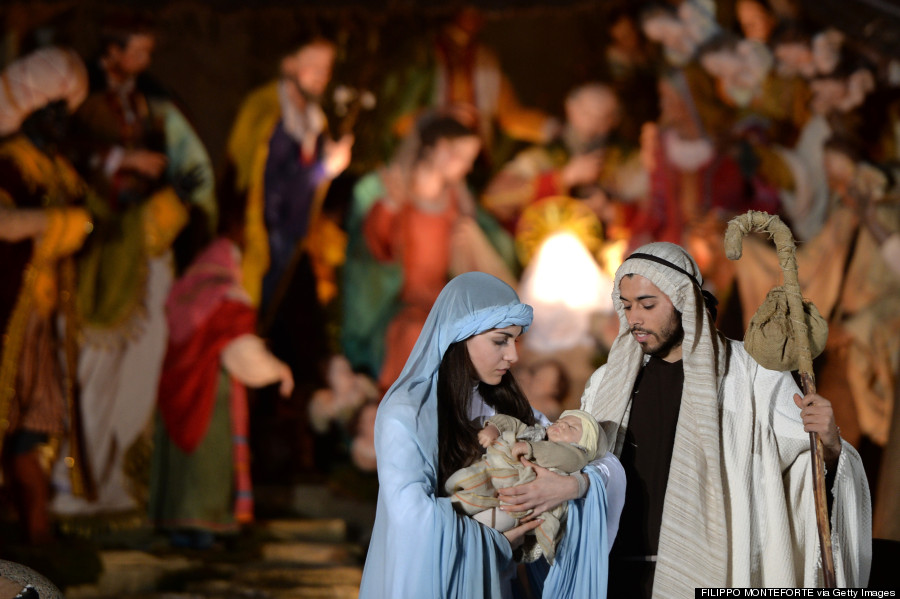
True to its dogma, therefore, Christmas is a time for celebrating humanity. Because at Christmas we celebrate a fully divine and fully alive human being. It is indeed the good news of Christmas that this Christian God, if he had ever given up His Godself (divinity) to become anybody else other than God, then he had chosen to become only a human being. Moreover, the Christ thus came to us as one like us and one among us was not just a mere human, but a lowly human being, born of a humble and God-fearing young girl, in a manger, visited not only by the most excluded of the then society – the shepherds, but also the animals as well, adorned with gold, frankincense, and myrrh by the magi, and heralded by the angels in heaven. 

Accordingly, the birth of the historical Christ and His eschatological second coming celebrated at Christmas is nothing but a feast of our own humanity irrespective of all types of human-made differences that exist within us and among us to various degrees and intensity. 

The true spirit of Christmas, therefore, should not be lost or diluted in the glamour of decorations, partying, merrymaking, shopping, cakes, eating, and drinking, etc. Rather, it is a season of contemplation. It should be ideally used to reflect how well we have preserved our humanity and how divine we have tried to become in each passing year as a way of reciprocating the divinity spelled out through the Christmas festival. It thus demands an inward-looking ness into oneself, irrespective of whatever status or position one enjoys or desires to enjoy in life and career, and an authentic answer to the question, what must we do?

Given our own context today in Sri Lanka, where there is an increase in general strife of people, an impending shortage of food and supplies, augmenting strikes and protests across the island, what one should ask right now is how better one should become as a human being. One of the day-to-day measures of this humanity is the extent to which one shares what one knows and has with those who have less or do not have at all. 

It is because taking the very words of John the Baptist, God who always takes the side of the oppressed has “His winnowing-fan in his hand, to clear his threshing-floor and to gather the wheat into his barn, but the chaff he will burn in a fire that will never go out.” (Luke 3:17, TJB). The justice thus explained is even true for all the belief systems and religions that espouse the concept of God or Good and, therefore, the power of God or Goodness is always on the side of the righteous, the good, the just, and the oppressed.

To conclude, therefore, let us not wait until it becomes too late and the perahera is gone to take to heart and act upon the true meaning of Christmas. Neither let us take it as an annual celebration that passes by and wait for the next year to repeat the same, perhaps with increased expenditure and superficiality. Rather, let us act right now, while the season is on, dwell in the mystery of God becoming human, grow in the humanistic call of Christmas throughout the New Year, and be a humble beacon of humanity to the lives of all around us.  


Saturday, 18 December 2021

Priestly Experience in Hingurakgoda, Sri Lanka

Fernando, R. (2021, December 18). Priestly experience in Hingurakgoda: Part II. Daily FT. https://www.ft.lk/harmony_page/Priestly- experience-in-Hingurakgoda-Part-II/10523-727751

Priestly Experience in Hingurakgoda, Sri Lanka

It brings always joy to recall my first-ever pastoral experience in Hingurakgoda church in the very first year of my priesthood. 

Upasaka Thaththa in Mission House

It was 16th September 2017, the first day of my arrival at Christ the King Church, Hingurakgoda. The first sight I had ever had of the place elated my spirit in that pleasant morning. An elderly person dressed in a white sarong with absolutely nothing to cover his torso was sweeping the compound just the way I have seen it being done by the samaneras (novices) and monks in the temple with quiet composure, serenity, and art. “I was told about your coming, Father. Have you eaten?” was the first-ever welcoming words I heard of anybody of that place and I am happy that they came from that upasaka thaththa (worshipful elder) who had some drops of sweat on his chest while speaking to me. ‘Could there be any better way to welcome a stranger than inquiring whether or not he or she is full’, I wondered. 

This mature being whom I soon learned about as the cook of the lagum ge (mission house) was an unmarried elder in his late 60s who had once been a monk in his youth. It was a different joy altogether to share the space with him in the same lagum ge. He was more than a cook to me. There was hardly anybody in the whole of 550 odd families in that church who had not drunk a cup of tea or eaten a piece of biscuit that this person has offered, often against the rule of the Fathers, because the observation of one hour of fasting before the Holy Mass is encouraged for all Catholics as a preparation for receiving the most precious body and blood of Christ during the celebration of the Holy Eucharist. His justification for doing so, more sneakily than overtly, was as simple and humane as ever: “Where on earth do people go to temples and churches having had their full? They all come not only to fill their souls but also their bellies. Don’t they, Father?” I was dumbfounded at his human-centeredness and I had nothing more to say than to nod affirmatively, “Why not, thaththta!” It has often been noted that he was the first person, even before the priest, to visit whosoever he heard of been hospitalized in the village for one reason or another, be it a pregnant mother, a sick child, or an ailing elder, etc. regardless of his or her faith. All of these visits he made were never empty-handed. He made sure to fetch something or the other from the mission house to take to that sufferer, be it a towel, a packet of milk or biscuits, etc. 

This devoted elder died on the way to Ederamulla during the Christmas octave in 2017 as he was going to see his beloved babies of a Christian household where he had worked earlier. There too he was found carrying a box of Christmas edibles collected from the mission house to be given to that family. The scene created at his burial in Kegalle, the far interior of a rubber estate, should be recounted. There was an extra enthusiasm of the Hingurakgoda parishioners to participate in this virtuous being’s last rights. Upon arrival at the place, almost at the time for pansekule (final rights according to the Buddhist rituals), we found this upasaka thaththa, dressed in a white sarong and a white shirt, lying in a very ordinary coffin with hardly anybody to cry over his death. It was however difficult for the Hingurakgoda parishioners to hide their tears. The priests were the first ones to burst into tears no sooner than they saw their feeder. Then the congregation joined, and I saw those babies and their parents too (confirmation of which I had much later) weeping hideously. As we were about to depart, the key organizer of the funeral household approached me and asked: “Sir, nobody cried from our side over his death, but from the time you all came, you have been crying unceasingly. What has he done so much that all you feel for him so much? It wasn’t the time for a lengthy explanation of what this noble person has been and done to us. Nevertheless, he should be witnessed. Thus, recalling chapter 25 of St. Mathiew’s gospel, I said: “We were hungry, and he gave us to eat. We were thirsty, he gave us to drink. We were sick and hospitalized, and he came to see us”.

Christmas Carols in Bana Shalawa  

In the same year, the Hungurakgoda church had an issue finding a place to have its annual Christmas carols. The next-door school hall (as it had usually been done in the past) too had become a no-entry zone for us because of its preoccupation with the GCE O/L exam preparations. Christmas was approaching and the children in the church were getting ready for their big day of the year. It was during this time that I paid a visit to the Hingurakgoda Buddhist temple as it was customary for me to visit the chiefs of co-denominations at the locality wherever I am and serve during the time of Christmas. This, I believe, is something that my family upbringing has bestowed on me. It is because at home we have been trained from our childhood to share food with our neighbors irrespective of their faiths, religions, beliefs, etc. during the time of Christmas and the Sinhala Tamil New Year. In my conversation with the chief monk that day, it happened that the issue of the concert hall that the church was facing popped out of my mouth. “Don’t worry Father. You can come and have the concert in the bana shalawa (temple hall). And for your tea, I will arrange fish buns for everybody. How many of you?” I became speechless. 

With joy, I came back to the church and recounted the good news to the church congregation which felt relieved. But there was a concern. “Father, what about that huge Buddha statue kept on the stage of the bana shalawa?” asked a person of mixed marriage who was familiar with both the environments in the temple as well as in the church. “Will not Lord Buddha be happy to see our children singing, dancing, performing, and shouting on the stage?” I asked. “But Father, we have to make the crib there as well” another added. “True, we’ll make it. I think it’s not that Lord Buddha and Jesus cannot live together on the same platform. Rather, it is we who cannot see them living together, not only on the stage but also in our day-to-day lives”, I was determined. 

It wasn’t however the first encounter I have had with the chief monk of the Hingurakgoda temple. Before that day, we had several occasions frequenting each other, during the time of the annual temple perahara (street procession), Sinhala-Tamil New Year, Ayurudu Uthsawaya, etc. with mutual support, invitations, and reservations. To name a few, while it has been the tradition of the youth association of the church to organize a dansala (almsgiving) during the time of perahara and on the day of Wesak, during the year of my stay in Hingurakgoda, the same dansala was conducted, but differently, in the form of shramadana launched to plant flag poles along the main street of the perahara. This was also participated by the young novices of the Jesuit Order who happened to be in the church at that time for their pastoral experiment.  

Rice, Seasons, and Life

The agricultural landscape in Hingurakgoda in the ancient waw badi rajye (kingdom of tanks) of Rajarata is seasonal. However, these seasons I found were not according to how they are being considered in Europe, or America, or elsewhere in the world. Rather, they were based on the rhythm of the activities attached to people’s main occupation - rice cultivation. 

When the fields were getting ready for sawing, it is the season of hard labor, plowing, and tilling the ground which I would call the gray season after the color of the fields, the color of the plowed earth. During this season, it is often hard to find men regular in the church or the temple. Then comes the vegetative phase of the rice plants which, according to me, is the green season, again after the color of the fields. It involves relatively less labor and, hence, more time for one’s personal, familial, social, and worship activities such as Sunday Mass, temple rituals, etc. The following season, according to me, is the blue season characterized by the reproductive phase of the rice plants. It is blue because of the anxiety that the season brings in. People are anxious during this stage of farming as to whether or not the plants would open up, be attacked by the insects, be destroyed by the elephant, or be supported with enough and regular water supply, etc. In short, during this season, they are anxious about protecting what they have labored for and maximizing the gain. It has been my experience in the church that adults are often reluctant to commit themselves to common responsibilities during this season because they need time for themselves to deal with the anxieties of life. Finally comes the harvest time or the golden season, named once again after the very color of the fields. It is during this season that one generally sees many smiling faces, loud talking of people, the town becoming increasingly active, people getting organized, family events, communal functions, and village carnivals being organized, and the church and the temple getting crowded. 

Thus, the seasons of life associated with the rhythm of people’s major livelihood in Hingurakgoda have a direct and significant influence on their religious observances and adherence to faith-related activities, thus witnessing the age-old symbiotic system of living in Sri Lanka known as Gamai, PansalaiWewai, Dagabai (Village, Temple School, Tank, Shrine). It was indeed important for me to be aware of the dynamics of these seasons to understand why people in Hingurakgoda behaved the way they did whether in the church, or the temple, or elsewhere in the village. 

Finally, one of the unifying factors I have experienced among the people of Hingurakgoda is their augmenting willingness to coexist with other faiths within and outside the marriage which is nonetheless not without troubles altogether. While visiting families and attending the funerals of both Catholics as well as Buddhists of the place, I had ample opportunities to experience their harmonious living, collective struggles, difficulties, and pains, as well as joys in life. I still remember the day when the parishioners came to know about my living in the lagum ge without a cook after the sudden death of that upasaka thaththa. The ones who became increasingly troubled upon realizing it, if I am not mistaken, were those in mixed marriages who got themselves hurriedly organized to bring meals to the church as it is been done in the temple by way of giving alms to saffron bearers who have voluntarily chosen the path to nibbana (enlightenment). 

Wednesday, 14 July 2021

"Don't cast your pearls before swine"

Fernando, R. (2021, December 13). The pigs, the dogs, and the pearl of the Indian ocean. The Morning. https://www.themorning.lk/articles/179002

Fernando, R. (2021, December 9). What to do with the pearl, the pigs & the dogs, my dear citizens? Colombo Telegraph. Fernando, R. (2021, December 9). What to do with the pearl, the pigs & the dogs, my dear citizens? Colombo Telegraph. https://www.colombotelegraph.com/index.php/what-to-do-with-the-pearl-the-pigs-the-dogs-my-dear-citizens/


"Don't Cast Your Pearls Before Swine"

    Recently, I have been encountering people who seem to share one common feeling towards the current situation of the Pearl of the Indian Ocean, Sri Lanka. Among them are highly learned personnel, university professors, senior lecturers, administrators, teachers, religious leaders, social analysts, thinkers, friends, and colleagues. All of them seem to be hinting quite overtly at one and the same thing: ‘This country is gone to the dogs. There is no way out. They ruin it and eat it up, the dirty pigs.’ It is this common opinion that reminds me of the proverb, “Don’t cast your pearls before swine” which has its origin in the Gospel of Mathew in the New Testament of the Bible, “Give not that which is holy unto dogs, neither cast ye your pearls before swine…” (Mathew 7:6, KJV).

    Even though such a gem of wisdom has been passed on to us for 2000 odd years, one could possibly argue that the truth of this wise saying is more justified today especially when it is seen against Sri Lanka in the current geopolitical contextual backdrop, than whatever may have been its original cause in history. It is needless, however, to cite examples here to substantiate this claim for two reasons: Firstly, because they are being rigorously and vehemently exposed and analyzed by the country’s popular media 24 X 7; secondly, because any such effort to replicate them here could and would definitely be looked at through colored glasses as catering (kade yanawa) to some vested interest or other. For better or for worse, it is, in fact, the bitter truth that almost all the news providers in the country today, be it TV Channels, Print Media, or Social Media, have their own agendas.

    The points of this essay, therefore, are the following four assumptions which are taken for granted as factual. 1) There is a famous country known as the Pearl of the Indian Ocean. 2) It is thrown. 3) It is thrown to the pigs. 4)It is gone to the dogs. What shall we do, then? It is indeed the main purpose of this essay. What shall we do with Sri Lanka, the Peal of the Indian Ocean, thrown to the pigs and gone to the dogs? This is perhaps the question that practically every intelligent Sri Lankan living in this country or outside it is asking at this moment in history. 

    Answering this question needs an explanation and it could be done better by understanding the following scenario. One day a motivational speaker asks the audience the following question after showing them a five-thousand-rupee note. Who wants this? Understandably, all the hands show up. Then, for the second time, he crunches the note in his hand and asked the same question again. Who wants this note, now? Once again, all the hands show up as quickly as possible. Then, for the third time, he tramples the note under his foot and asks the same question once again. Now, who wants this note? Still, almost all the hands show up except for a few indecisive ones raised reluctantly halfway through. Then, for the last time, the speaker shreds the note into pieces and asks the same question again. Well, who wants it, now? All the hands which were very enthusiastic till that moment drop lifeless as the audience sinks back in their seats in dismay. While many start murmuring against the speaker, a courageous few vent their frustration out aloud spontaneously. Is it not the fate of the Pearl of the Indian Ocean thrown to the pigs and gone to the dogs at this moment in its history?

    It is commonly known that pearls, as they are precious, should be given to those who know their worth and appreciate their beauty. By throwing them to the pigs instead, we not only devalue the pearls but we neither enhance the value of the pigs. For the pigs do not use them for the right purpose they are meant to be used for. However, there is something more here that we often miss as in the case of the five thousand rupee note of the motivational speaker. That is, no matter whether it is thrown to the pigs or trampled upon or muddied with dirt, the pearls always remain pearls until their pearliness is ruined and robbed. Imagine for a second; supposing actually you see a pearl thrown to the pigs. Do you not pick it up even if it happens to be in the dirtiest place of the piggery? Likewise, it should be kept in mind that no matter how precious are the pearls that are thrown at the pigs, the pigs always remain pigs. Think for a second again; if you find a pearl under the foot of a pig, do you carry that pig in your arms, pet it, and put it on your pillow? I am afraid, not! Rather, one would perhaps barbeque the pig to celebrate the joy of finding a pearl.

    There is another aspect here we often tend to overlook. I believe a better understanding of it would definitely lead people towards certain progressive measures needed to be taken concerning these two areas: 1) A thorough cleaning of the pearls found in the piggery to re-establish their original beauty;  2) Right barbequing the pigs to satisfy one’s desired taste. It is important therefore to understand that neither the pearls nor the pigs change their nature from being pearls or pigs as the giving-up of the pearliness or the pigginess is impossible. It is a sure impossibility because the moment they manage to do so they cease to be pearls or pigs and the entire initial proposition becomes invalid. What is needed therefore is to understand that none of them, neither the pearls nor the pigs, are the doers of the action. Rather it is a third party who is the agent who decides either to throw the pearls to the pigs or to make a necklace out of them. Or having found the pearls under the feet of the pigs, either to leave them there or to pick them up and cleanse them. Or, having collected the pearls, either to pet the pigs in the bedroom or to have them barbequed in celebration of the pearls found. It is the same when it comes to the Pearl of the Indian Ocean, the nation of Sri Lanka as well.

    Unless this third party makes its decision about the Pearl wisely, correctly, and quickly, the Pearl risks being shifted from ‘thrown to the pigs’ to ‘gone to the dogs’. Either way, the Pearl will always remain a pearl but in a place where it does not belong, in the piggery or in the kennel.