Fernando, R. (2022, January 1). Christmas: A season to celebrate humanity. Daily FT. https://www.ft.lk/harmony_page/Christmas-A-season-to- celebrate-humanity/10523-728471
The word perahera often rings in us, Sri Lankans, the images of the traditional annual procession of the Temple of the Tooth in Kandy wherein an adorned tusker carries the sacred tooth relic of the Lord Buddha amidst an array of folklore dancers and performers. The Esala Perahera, the crème de la crème of Sri Lanka’s proud traditional heritage, is not just a mere procession. Rather it marks an auspicious season, a time of spiritual renewal and festivity. It is also the case with Christmas, the annual liturgical celebration of the first birth as well as the second coming of Christ, the promised messiah, according to Roman Catholic belief.
To begin with, the perahera by and large consists of at least two key segments: the precursors and the arrival of the sacred relic on a venerated carrier. While the precursors announce the coming of the sacred one, prepare the way for Him, and adorn the path of His coming, the arrival of the sacred one is met with incessant worships, prostrations, and genuflexions by the onlookers, the faithful, the devotees, and the adherents. Likewise, the season of Christmas, liturgically speaking, could be articulated in terms of two key epochs, each with a key personality figure as the champion heralding a designated time: the time of advent and the time of Christmas.
John the Baptist and the Advent
Metaphorically speaking, just as the whip crackers, the fire dancers, and other traditional dances of the perahera prepare the way for the arrival of the holiest, John the Baptist, according to the Gospel narratives, is the precursor of the messiah to come. Living a hermit life, he had his raiment of camel’s hair, a leather girdle about his loins, and locusts and wild honey to feed on. He prepared the people to receive the promised one of whom the ancient prophets have foretold. While his preparatory speech was as fiery as ever, it is perhaps more relevant to our present-day context than it was then:
When all the people asked him, ‘What must we do, then?’ He answered, ‘Anyone who has two tunics must share with one who has none, and anyone with something to eat must do the same.’ There were tax collectors, too, who came for baptism, and they said to John the Baptist, ‘Master, what must we do?’ He said to them, ‘Exact no more than the appointed rate.’ Some soldiers asked him in their turn, ‘What about us? What must we do?’ He said to them, ‘No intimidation! No extortion! Be content with your pay!’ (Luke 3:10-14, TJB)
The greatness of this champion was that he understood his role in the plan of God’s salvation as a precursor and acted as much as it demanded of him, ever humanly, humbly, and authentically.
Mary, the Mother of Christ, and Christmas
Just as a venerated tusker carries the relic of the most sacred one in the perahera, the coming of the most awaited time of Christmas is marked by another humblest of human beings, the mother of Jesus Christ. It is she who bore not only the hard truth of virginal birth, as is the Christian belief, at the annunciation but also the true fruit of it – the word-made flesh. The Lucan narrative is so candid in bringing about how God was so bent on receiving the consent of this lowly human being in His economy or plan of salvation: “Mary said, ‘You see before you the Lord’s servant, let it happen to me as you have said.’ And [then] the angel left her.” (Luke 1:38, TJB)
The birth of Christ and the celebration of humanity
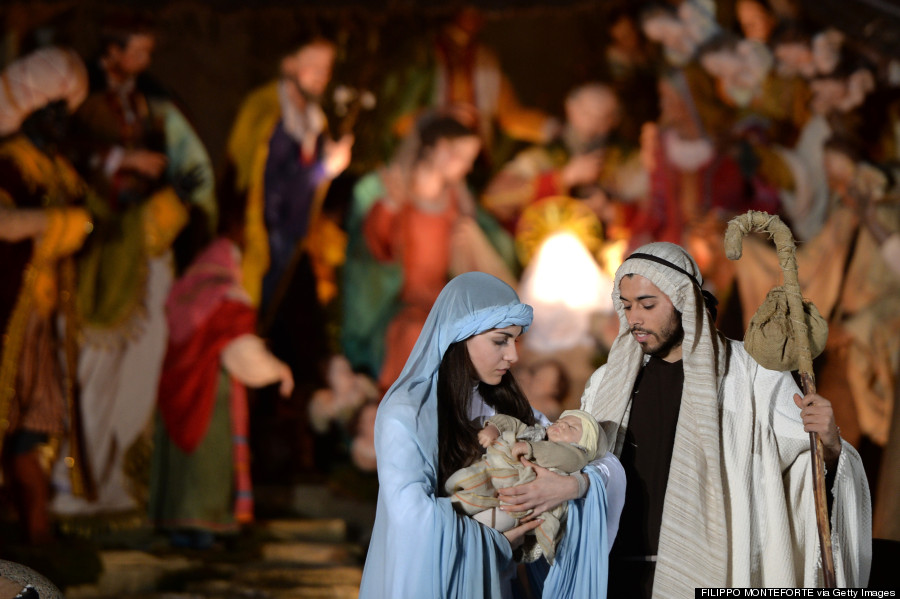
True to its dogma, therefore, Christmas is a time for celebrating humanity. Because at Christmas we celebrate a fully divine and fully alive human being. It is indeed the good news of Christmas that this Christian God, if he had ever given up His Godself (divinity) to become anybody else other than God, then he had chosen to become only a human being. Moreover, the Christ thus came to us as one like us and one among us was not just a mere human, but a lowly human being, born of a humble and God-fearing young girl, in a manger, visited not only by the most excluded of the then society – the shepherds, but also the animals as well, adorned with gold, frankincense, and myrrh by the magi, and heralded by the angels in heaven.
Accordingly, the birth of the historical Christ and His eschatological second coming celebrated at Christmas is nothing but a feast of our own humanity irrespective of all types of human-made differences that exist within us and among us to various degrees and intensity.
The true spirit of Christmas, therefore, should not be lost or diluted in the glamour of decorations, partying, merrymaking, shopping, cakes, eating, and drinking, etc. Rather, it is a season of contemplation. It should be ideally used to reflect how well we have preserved our humanity and how divine we have tried to become in each passing year as a way of reciprocating the divinity spelled out through the Christmas festival. It thus demands an inward-looking ness into oneself, irrespective of whatever status or position one enjoys or desires to enjoy in life and career, and an authentic answer to the question, what must we do?
Given our own context today in Sri Lanka, where there is an increase in general strife of people, an impending shortage of food and supplies, augmenting strikes and protests across the island, what one should ask right now is how better one should become as a human being. One of the day-to-day measures of this humanity is the extent to which one shares what one knows and has with those who have less or do not have at all.
It is because taking the very words of John the Baptist, God who always takes the side of the oppressed has “His winnowing-fan in his hand, to clear his threshing-floor and to gather the wheat into his barn, but the chaff he will burn in a fire that will never go out.” (Luke 3:17, TJB). The justice thus explained is even true for all the belief systems and religions that espouse the concept of God or Good and, therefore, the power of God or Goodness is always on the side of the righteous, the good, the just, and the oppressed.
To conclude, therefore, let us not wait until it becomes too late and the perahera is gone to take to heart and act upon the true meaning of Christmas. Neither let us take it as an annual celebration that passes by and wait for the next year to repeat the same, perhaps with increased expenditure and superficiality. Rather, let us act right now, while the season is on, dwell in the mystery of God becoming human, grow in the humanistic call of Christmas throughout the New Year, and be a humble beacon of humanity to the lives of all around us.

