To read the texts, click on the texts: Rev 11:19; 12:1-6,10;1 Cor 15:20-26; Lk 1:39-56
On the 1st of November 1950, the Holy Catholic Church, together with then Pope Venerable Pius XII, took a significant leap in its catholic doctrines, and with that, the entire humanity was elevated or raised to a level that no created being had ever achieved before. And that is what we celebrate today.
Today, we celebrate the assumption of the Blessed Virgin Mary, the feast of Mary taken into heaven with her entire body and soul following the end of her life on earth.
This is our feast. This is the pride of humanity. It is because this human woman, who lived a flesh and blood life like any one of us on earth, was given that highest honor, which is second to nobody but Christ, the son of God, the new Adam, who was taken up to heaven with his entire body and soul after his death and resurrection.
We go to celebrate with Mary because, humanity, which has been created after the image and likeness of God, yet fallen due to its own pride, was forgiven and restored back to its original state through this human woman, this new Eve, whose name was Mary, a Canaanite woman, who was raised up like any other girl-child in Judea, who went about attending to the daily chores perhaps with her bear feet, who fetched water like any other woman at a common well, who was faithful to her promise or ‘yes’ to the Lord come what may, and as a result who was so chosen by God to mother and nurture his own son, the savior, our Lord Jesus Christ.
On this feast day, as we hail Mama Mary for living a life so dignified, so exemplary, so chosen, so wanted, and so honored as a creature by the creator, we ask a few questions:
What is it that God saw in her so much that he was so bent on not only choosing her but also glorifying her in his economy or plan of salvation?
Despite all the qualities and attributes, names, praises, and honor that we could ever give to Mary, our mother, if we fail to realize that one thing that God was so attracted to in her, I think we are going to miss the point here.
It is nothing but her lowliness. And she sings it well in the Magnificat as follows:
My soul proclaims the greatness of the Lord, my spirit rejoices in God my savior, for he has looked with favor on his lowly servant….
He has mercy for those who fear him in every generation…
He has scattered the proud in their conceit, he has cast down the mighty from their thrones, and has lifted up the lowly….
When it comes to Mary, while she gives all glory, pride, honor, and greatness to God, her greatness was found in her humility…her humble faithfulness to the Lord…
You see, my dear sisters and brothers, while it is pride that was the reason for the fall of not only humanity but also the angels, as it is believed in the tradition of Christianity, it is lowliness/humility which is the point of salvation…
This applies to us today as well…In my personal life, in my life with the family, in my marital vows, how humble and how faithful I am to God, to myself, to one another…Or has my pride taken me over, bogged me down, and constrained me into my earthly living in conceit, lies, deceit, false image and likeness, and putting up an altered self or ego before me and before others, finally leading into sin, pain, disharmony, and destruction with myself, with one another, and with the entire creation?
How “heavy” am I today so that even God finds it difficult to lift me up like Mary our Mother?
If God is to choose one of us today, how humble, how lowly, how ready, how simple, and how pleasing would he find me today that he would not be able to pass me by without choosing me just as he chose Mama Mary?
Friday, 15 August 2025

Friday, 18 July 2025

Saturday, 5 July 2025
The Challenge of Parenting in Today’s World | Daily Reflection
The Challenge of Parenting in Today’s World
To read the texts, click on the texts: Gen 27:1-5,15-29; Mt 9:14-17Over the past few months, I was humbled by the way many of you have reached out personally, sharing how some of my previous reflections on family and parenting have touched your hearts. You’ve opened up about the deep generational gaps between grandparents, parents, and grandchildren today—gaps filled with confusion, frustration, and sometimes grief. Your honesty has reminded me how profoundly this struggle is felt in many homes and hearts. No doubt, parenting today feels more complex than ever. With shifting values, constant noise from social media, and generational differences, both parents and children often struggle to understand one another.
In today’s reading from Genesis, we see a family caught in deception and favoritism. Isaac’s desire to bless Esau is disrupted by Rebekah and Jacob’s plan. Their actions reveal a family divided by fear, expectation, and the need for honor, prestige, and acceptance. Here, we are reminded that even in families blessed by God, brokenness, favoritism, and misunderstanding can creep in. Today’s parents and children face similar struggles—trust, identity, expectations, and the desire for inheritance, validation, blessings, and love. Parents, like Isaac, are doing their best—sometimes without full awareness of their children’s hearts. Children, like Jacob, may feel unseen or pressured to become someone they’re not, just to be accepted or meet their personal agendas, which their parents are incapable of grasping.
It is in this sense that Jesus’ words in the Gospel could make good sense: “New wine must be poured into fresh wineskins.” Parenting and family life must evolve with grace. Children completely disregarding family values, traditions, and parental guidance, and parents excessively holding on to their rigid roles and non-negotiable expectations, can cause more harm than good. Christ’s appeal for new wine into new skins, therefore, calls for both parents and children to renewal—a willingness to accommodate, care, and grow—both within and together as a family. The brokenness is real, but so is God’s presence in it. While Psalm 135 reminds us that the Lord is good and chooses us despite our flaws, let us remember that God worked through Jacob’s story, not because of the deception (which is ours), but because of His love that redeems us, despite our messy family dynamics.
- In what ways might I need to listen more closely to the voice of Christ in my family relationships?
- How can I create a “new wineskin” in me in the way I relate to my parents or my children today?
Thursday, 5 June 2025
Called to Oneness in Love | Daily Reflection
To read the texts, click on the texts: Acts 25:13-21; Jn 21:15-19
In today’s Gospel (John 17:20-26), we are drawn into the heart of Jesus’ prayer—the night before His Passion. This is no ordinary prayer. It is intimate, profound, and overflowing with love. Jesus lifts His eyes to heaven and speaks to the Father not only on behalf of His disciples but for all who would believe through their word—that includes us today.
The central desire of Jesus’ prayer is unity: “that they may all be one, as you, Father, are in me and I in you.” This oneness is not about uniformity but communion—a deep connection grounded in love, truth, and divine presence. Jesus wants us to share in the same loving relationship He shares with the Father, to be drawn into the eternal embrace of God.
This unity is not just spiritual or symbolic. It has real implications for how we live, love, and relate to one another. Jesus gives us the glory He received—not for personal elevation, but to draw us into divine life. He prays that we may be “brought to perfection as one,” so that the world might believe in the love that sent Him.
At the heart of this prayer is an incredible truth: we are God’s gift to Jesus. This is how much we are loved. And this love is not distant or abstract—it desires to dwell in us: “that the love with which you loved me may be in them, and I in them.” Let this prayer of Jesus echo in your heart: I am loved, I am called, and I am one with Him.
As we reflect, let us examine ourselves:
Do I live with the awareness that I am deeply loved and united to God?
Am I an agent of love and unity in my family, community, or workplace?
What changes ought I make in my to-do list to bring about that love and unity in and around me?
In today’s Gospel (John 17:20-26), we are drawn into the heart of Jesus’ prayer—the night before His Passion. This is no ordinary prayer. It is intimate, profound, and overflowing with love. Jesus lifts His eyes to heaven and speaks to the Father not only on behalf of His disciples but for all who would believe through their word—that includes us today.
The central desire of Jesus’ prayer is unity: “that they may all be one, as you, Father, are in me and I in you.” This oneness is not about uniformity but communion—a deep connection grounded in love, truth, and divine presence. Jesus wants us to share in the same loving relationship He shares with the Father, to be drawn into the eternal embrace of God.
This unity is not just spiritual or symbolic. It has real implications for how we live, love, and relate to one another. Jesus gives us the glory He received—not for personal elevation, but to draw us into divine life. He prays that we may be “brought to perfection as one,” so that the world might believe in the love that sent Him.
At the heart of this prayer is an incredible truth: we are God’s gift to Jesus. This is how much we are loved. And this love is not distant or abstract—it desires to dwell in us: “that the love with which you loved me may be in them, and I in them.” Let this prayer of Jesus echo in your heart: I am loved, I am called, and I am one with Him.
As we reflect, let us examine ourselves:
Do I live with the awareness that I am deeply loved and united to God?
Am I an agent of love and unity in my family, community, or workplace?
What changes ought I make in my to-do list to bring about that love and unity in and around me?
Thursday, 8 May 2025
Habemum Papam - We have a Pope

When You See the White Smoke…
Don’t think of prestige. Don’t rush to post, to speculate, or to celebrate power.
Because the man who will soon step out onto the central balcony of St. Peter’s Basilica is not claiming a throne—but embracing a cross.
He is not a victor, but a sacrificial lamb chosen to lead a weary world.
At that very moment, he may be in the small, hidden “Chapel of Tears” beside the Sistine Chapel—weeping. Not in triumph, but in awe and fear, asking God:
“Why me?”
He will recount his frailties. He will list every reason why he feels unworthy.
But God will not need strength—He will give mercy.
This man will carry the full weight of Peter’s office.
He will grow tired.
He will suffer silently.
He will grow old—perhaps too soon.
He will not retire in comfort.
He will die in service.
His burden will be unseen by many, but his soul will feel it every day.
When you see the white smoke... pray for him.
He is not stepping into glory—he is walking into sacrifice.
Viva Papa Leo XIV! 
Thursday, 1 May 2025
Power Through Humility, Obedience, and Trust in God | Daily Reflection
Power Through Humility, Obedience, and Trust in God
To read the texts click on the texts: Acts 5:27-33; Jn 3:31-36At the heart of today’s readings is Jesus and the apostles’ unwavering witness to God—not through grand displays of power, but through voluntary obedience. Though often misunderstood as weakness or naïveté, both in the time of Jesus and in our own day, this obedience is a radical one rooted in love, humility, and deep faith in God’s providence. Jesus spoke and showed the truth of God from his intimate knowledge of Him, yet many did not believe him, just as many today struggle to believe in God who walks among us, who heals through touch, who suffers, and who dies. Perhaps, the expectation of a magical, otherworldly messiah—one descending from the clouds with instant solutions—made it hard for people then and to this day to accept Jesus, who came from a humble background, lived a very human life, and died a very human death. It is precisely in this humanity that God’s plan unfolds. The post-resurrection perspective makes this even more profound as we see that Jesus’ earthly life was not a detour from divinity, but the very path through which God revealed himself as deeply present, approachable, and trustworthy. Jesus’ voluntary obedience—even unto death—is not weakness but the clearest sign of divine love.
While the Psalmist reminds us, “The Lord is close to the brokenhearted; and those who are crushed in spirit he saves,” it is this God that Peter and the apostles boldly witness to in the first reading when they declare, “We must obey God rather than men.” It is a powerful testimony of faith in a higher authority, one that calls for loyalty even in the face of persecution. Their witness is not founded on personal gain or fear, but on their personal experience of the risen Christ and the transformative power of the Holy Spirit. They obey, not because they are naive, but because they have tasted the goodness of God and know that His love is more trustworthy than any human promise or power.
Apostles’ testimony, like Jesus’, invites us to a faith that is not based on spectacle but on trust, intimacy, and love; not on a magical myth, but in a God who chose to become real, touchable, and knowable. And in doing so, it reminds us that true power lies in surrender, true strength in obedience, and true salvation in trust. After all, if we cannot trust and obey the God who walked among us—who was born, lived, suffered, and died like and with us, but in sin—what guarantee do we have that we will place our faith in and obey a being who is distant from our reality?
- Am I willing to trust in God who chooses to walk with me in my humanity, or do I still look for signs of divine power that fit my expectations of strength and control?
- In what areas of my life do I resist surrendering to God's will, mistaking obedience for weakness instead of seeing it as an act of radical love and trust?
Saturday, 26 April 2025
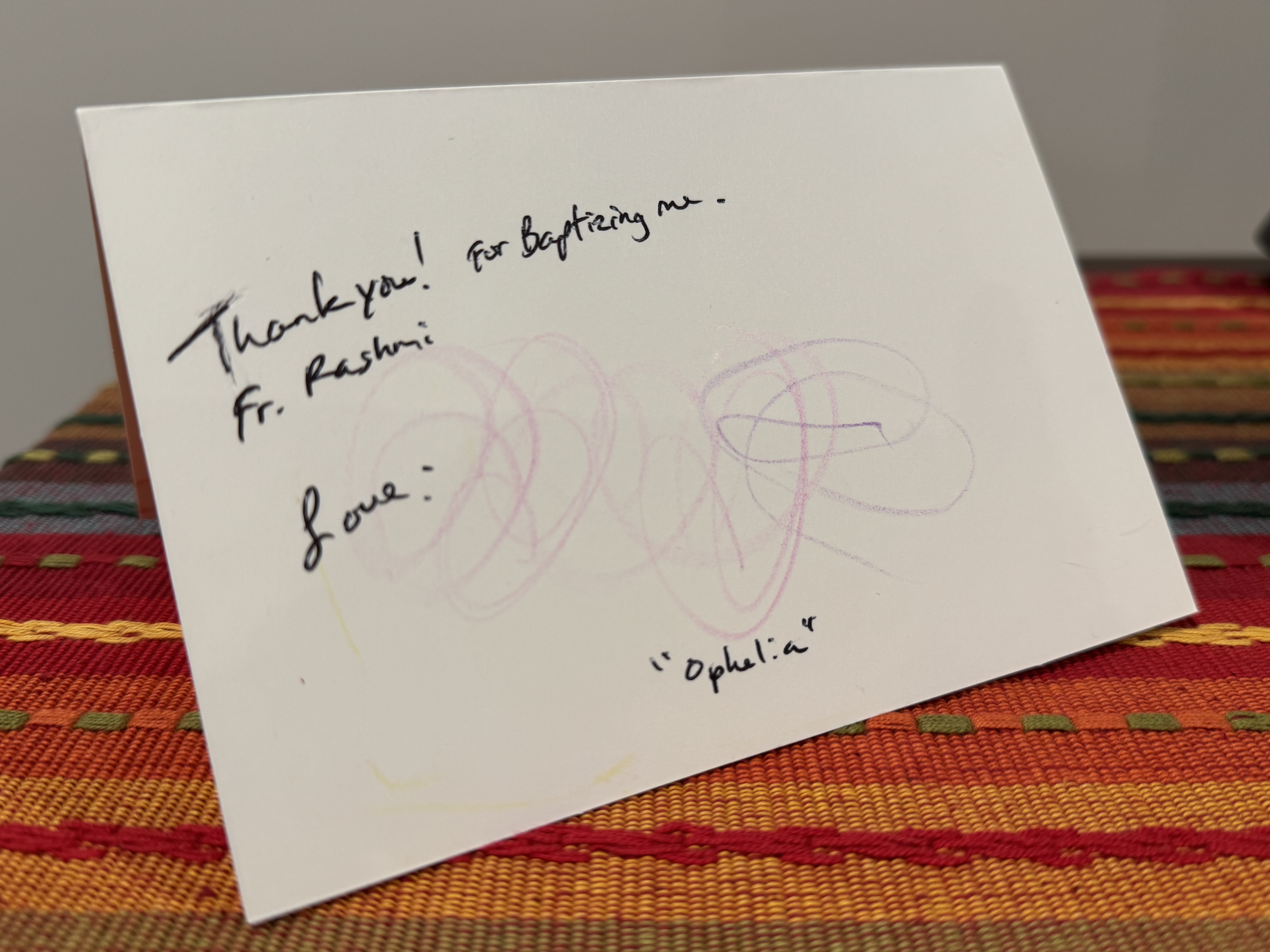
The Gift of Mercy and The Gift of Baptism...

My first-ever prayer request for the Holy Father, therefore, was, "Dear Holy Father, remember Ophelia when you come into His kingdom!"
It was a moment of deep and overwhelming emotion for me as a priest, as I reflected on how God's living word continues to be fulfilled: "Go, therefore, and baptize them in the name of the Father, and of the Son, and of the Holy Spirit."
I was reminded of the great Jesuit missionaries of the past — St. Francis Xavier, who tirelessly spread the Gospel in India and across Asia, and St. Matteo Ricci, who brought the light of Christ to China. Now, here I am, a Jesuit from the island nation of Sri Lanka, standing on American soil, baptizing a child into the faith.
On this sacred day, when God’s infinite mercy was first entrusted as a gift to the disciples — to be carried in their hearts as they were sent forth to the ends of the earth — I was humbled to be a part of that same mission.
Alleluia!
It was a moment of deep and overwhelming emotion for me as a priest, as I reflected on how God's living word continues to be fulfilled: "Go, therefore, and baptize them in the name of the Father, and of the Son, and of the Holy Spirit."
I was reminded of the great Jesuit missionaries of the past — St. Francis Xavier, who tirelessly spread the Gospel in India and across Asia, and St. Matteo Ricci, who brought the light of Christ to China. Now, here I am, a Jesuit from the island nation of Sri Lanka, standing on American soil, baptizing a child into the faith.
On this sacred day, when God’s infinite mercy was first entrusted as a gift to the disciples — to be carried in their hearts as they were sent forth to the ends of the earth — I was humbled to be a part of that same mission.
Alleluia!
Subscribe to:
Posts (Atom)